
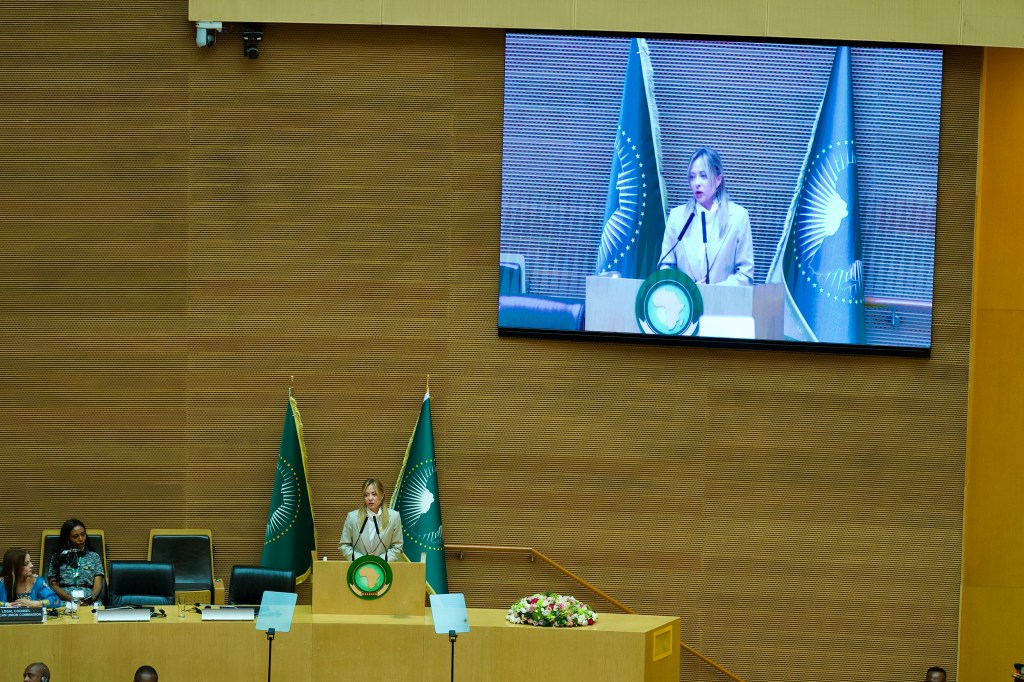
Presidents, Prime Ministers, Authorities, Ladies and Gentlemen,
It is a great honor for me to be here with you today, and I would like to express my heartfelt thanks once again to President Youssouf and President Lourenço, as well as to all of you, for this historic opportunity offered to Italy.
The invitation to participate in the Assembly of Heads of State and Government of the African Union, the forum in which this organization discusses its fundamental political choices and determines the strategic direction of the continent, is a recognition that can only make Italy proud and that Italy accepts with respect and a sense of responsibility. It is a demonstration of trust that we will not disappoint.
I have the honor to lead a nation that has in its DNA characteristics that historically make it a respected and valued partner: propensity for dialogue, capacity for discussion, and respect for others before anything else. A nation that has built part of its identity, and its foreign policy, on the profound meaning of a word that, in times as unstable and unpredictable as ours, can be the key to charting the course. That word is “cooperation”. The word cooperation comes from the Latin “cooperari,” “to work with.” True cooperation, that is, never sees an active and a passive subject, but exists only in a relationship between equals, a relationship in which the specificities of each one are indispensable for achieving a common goal. If you look down on someone, you cannot cooperate with them. If you want to plunder their resources, you are not cooperating with them. Even if you just want to give charity, you cannot call it cooperation, for cooperation is another thing.
And what Italy wants to do is to cooperate.
Yesterday, together with many of you, we attended the second Italy-Africa Summit, the first ever to be held on this continent. I would like to thank the Ethiopian Prime Minister, my friend Abiy Ahmed, and the leaders of the African Union for their hospitality and cooperation in organizing the event. In that context, we discussed what we can do to further strengthen and consolidate one of the most concrete outcomes of this idea of cooperation: the Mattei Plan for Africa. The investment plan that Italy has implemented in various nations on the continent, in areas ranging from infrastructure to agriculture, from health to training. This is a strategy that we have built together, because we do not conceive of the Mattei Plan as an Italian plan ‘for’ Africa, but as Italy’s contribution to ‘your’ agenda, with a particular focus this year on water-related projects.
It is an open platform for putting our know-how, our technologies, and our investments at the service of the objectives that the African Union has set out in Agenda 2063, starting with the creation of a continental free trade area that is integrated and prosperous. This is an ambitious goal, which we support and which will require efficient, secure, and fast economic interconnections in order to be achieved.
Like the Lobito Corridor, the railway and infrastructure backbone that will connect African markets to global ones and bring people, ideas, and economies closer together. A strategic project that sees Italy at the forefront, together with the United States and the European Union.
In short, the Mattei Plan is a comprehensive strategy that generates concrete benefits for our peoples and aims to continually expand its scope, relying on the irreplaceable contribution of major United Nations agencies – and I want to thank the Secretary-General António Guterres – but also the World Bank, the African Development Bank, and many other partners who increasingly share our vision.
Two years ago, in Rome, we set out the course together, and in recent years we have followed it with consistency and determination, adding a new piece to the mosaic each time and bringing new nations on board every year. We have done so on many fronts, starting with what I consider to be crucial for building a truly free Africa capable of determining its own destiny: addressing the issue of debt. We wanted to chart a course on this issue as well. Therefore, Italy has decided to launch a vast program to convert the debt of African nations, which includes, among its main points, the complete transformation of the debt of the most fragile and vulnerable countries into investments, and the strengthening of the contribution to the World Bank’s IDA funds.
Similarly, we have introduced specific debt suspension clauses into our bilateral loans, allowing African nations affected by extreme weather events to free up fiscal space to help their populations and rebuild essential infrastructure.
These are choices based on justice and responsibility, which are crucial for freeing up resources that are vital for development and for ensuring peace and prosperity, including in those areas of the continent that are currently more affected than others by instability, insecurity, and serious humanitarian crises, such as neighbouring Sudan and eastern Democratic Republic of the Congo.
But we also want our collaboration to be political at the multilateral level. We want to help strengthen the valuable work carried out daily by the African Union, ensuring greater consistency in the mediation activities carried out by the UN, the European Union and key international partners. We will continue to do our part, because we are aware that the future of Italy and Europe also depends on a secure, prosperous, and peaceful Africa.
It is often said, in the many analyses of the troubled and complex times we are living in, that history has started running again. This is true. And my opinion is that today it is running here. Africa is not a marginal chapter in this story, far from it, and those who do not understand this scenario risk being left behind. But those who understand this scenario see the reality: a continent with a thousand peculiarities and a thousand demands, some of which are very different from each other.
A continent rich in resources, raw materials, and arable land, which can count on a decisive force in the age of knowledge: human capital. This is why Italy has focused much of its energy on training projects for young people, including in the field of artificial intelligence.
In short, our point of view is that Italy and Europe cannot think about the future without taking Africa into proper consideration. Because our future also depends on yours.
Aware of this, Italy intends to continue to be a privileged bridge between Europe and Africa, making available the strength of its institutions, its great tradition of dialogue, and the expertise of its companies. We want to do this, also to achieve another goal that we all consider momentous. To guarantee the men and women of this continent a freedom that has often been denied them: the freedom to choose to remain in their country, to contribute to its growth without being forced to leave it, often paying unscrupulous traffickers to risk their lives in an attempt to cross the Mediterranean.
“Those who believe that migration is necessary and indispensable are in fact acting selfishly. If young people leave their land and their people in pursuit of the promise of a better life, what will become of the history, culture, and existence of the country they have abandoned?”. These words are not mine, nor those of a political leader, but of a son who is proud of Africa and who holds Africa’s future close to his heart, the Guinean Cardinal Robert Sarah.
Clearly, in order to guarantee the right not to have to emigrate, it is necessary to offer concrete opportunities for training and work, to enhance human capital and improve the quality of education, invest in skills and educational systems, and create industrial partnerships and joint ventures capable of generating stable, quality employment in the territories.
This is our mission, which is being put into practice in the many initiatives that Italy is promoting, including together with the African Union. And what I would like to see today, in this solemn place dedicated to another great son of a free and proud Africa, Nelson Mandela, is a great alliance between us to put training, research, universities, and innovation at the center of our common commitment. An alliance aimed not at taking away talent, but at multiplying it and building a model of development that respects people and values different identities.
Presidents, Prime Ministers, dear friends,
Pliny the Elder, one of the most famous historians of Ancient Rome, said that “something new always arises from Africa.” So, my wish for each of us is that something new may truly arise from today’s meeting.
Something that no one expects, or that many considered impossible, for impossible is usually the word that people without courage use. Something capable of astonishing the world and suddenly making everything we have seen so far seem trivial.
I thank you all.
****
Signori Presidenti, Signori Primi Ministri, Autorità, Signore e Signori,
è un grande onore per me essere qui con voi oggi e ringrazio di cuore, ancora una volta, il Presidente Youssouf e il Presidente Lourenço, così come tutti voi, per questa storica opportunità offerta all’Italia.
L’invito a partecipare all’Assemblea dei Capi di Stato e di Governo dell’Unione Africana, la sede nella quale questa organizzazione discute le sue scelte politiche fondamentali e determina gli indirizzi strategici del Continente, è un riconoscimento che non può che inorgoglire l’Italia e che l’Italia accoglie con rispetto e senso di responsabilità. Si tratta di una dimostrazione di fiducia che non deluderemo.
Ho l’onore di guidare una Nazione che ha incise, nel proprio DNA, alcune caratteristiche che storicamente la rendono un interlocutore stimato e apprezzato: la propensione al dialogo, la capacità di confronto, il rispetto per gli altri prima di ogni altra cosa. Una Nazione che ha costruito un pezzo della sua identità, e la sua politica estera, sul significato profondo di una parola che, in un tempo tanto instabile quanto imprevedibile come il nostro, può essere la chiave di volta per tracciare la rotta. Quella parola è “cooperazione”. La parola cooperazione ha origine dal latino “cooperari”, “lavorare con”. La vera cooperazione, cioè, non vede mai un soggetto attivo e uno passivo, ma esiste solo nel rapporto tra pari, un rapporto nel quale le specificità di ciascuno sono indispensabili per raggiungere l’obiettivo comune. Se guardi i tuoi interlocutori dall’alto in basso, non puoi collaborare con loro. Se vuoi depredare le loro risorse, la tua non è cooperazione. Anche se vuoi solo fare beneficenza, non puoi definirla cooperazione, perché la cooperazione è un’altra cosa.
E ciò che l’Italia vuole fare è cooperare.
Ieri, con molti di voi, eravamo al secondo Vertice Italia-Africa, il primo nella storia a tenersi in questo Continente. Vorrei ringraziare il Primo Ministro etiope, il mio amico Abiy Ahmed, e i vertici dell’Unione africana, per l’accoglienza e la collaborazione nell’organizzazione di tale evento. In quel contesto abbiamo ragionato insieme su ciò che possiamo fare per rendere ancor più forte e radicato uno dei frutti più concreti di questa idea di cooperazione: il Piano Mattei per l’Africa. Il piano di investimenti che l’Italia ha messo in campo in diverse Nazioni del Continente, su materie che vanno dalle infrastrutture all’agricoltura, dalla salute alla formazione. Una strategia che abbiamo costruito insieme, perché noi non concepiamo il Piano Mattei come un piano italiano “per” l’Africa, ma come il contributo dell’Italia alla “vostra” agenda, con un’attenzione particolare dedicata, quest’anno, ai progetti legati all’acqua.
È una piattaforma aperta per mettere il nostro know-how, le nostre tecnologie, i nostri investimenti al servizio degli obiettivi che l’Unione Africana ha fissato nell’Agenda 2063, a partire dalla creazione di un mercato continentale di libero scambio, integrato e prospero. Un traguardo ambizioso, che noi sosteniamo e che per essere raggiunto avrà bisogno di interconnessioni economiche efficienti, sicure e veloci.
Come il Corridoio di Lobito, la dorsale ferroviaria e infrastrutturale che collegherà i mercati africani a quelli globali e che avvicinerà persone, idee, economie. Un progetto strategico che vede l’Italia in prima fila, insieme agli Stati Uniti e all’Unione Europea.
Insomma, il Piano Mattei è una strategia a tutto campo che genera benefici concreti per i nostri popoli e che ambisce ad allargare sempre di più il suo raggio d’azione, potendo contare sull’insostituibile contributo delle maggiori agenzie delle Nazioni Unite – e ringrazio il Segretario Generale António Guterres – ma anche della Banca Mondiale, della Banca Africana di Sviluppo e di tanti altri partner che, sempre di più, condividono la nostra visione.
Due anni fa, a Roma, abbiamo indicato insieme la rotta, e in questi anni l’abbiamo seguita con costanza e determinazione, aggiungendo di volta in volta un nuovo tassello al mosaico, e coinvolgendo ogni anno nuove Nazioni. Lo abbiamo fatto su tanti fronti, a partire da quello che reputo decisivo per costruire un’Africa davvero libera e capace di determinare il proprio destino: affrontare la questione del debito. Anche su questo abbiamo voluto indicare la rotta. Così, l’Italia ha deciso di lanciare un vasto programma di conversione del debito delle Nazioni africane, che prevede, tra i suoi punti principali, la trasformazione integrale del debito dei Paesi più fragili e vulnerabili in investimenti, e il rafforzamento del contributo ai fondi IDA della Banca Mondiale.
Allo stesso modo, abbiamo introdotto nei nostri prestiti bilaterali delle specifiche clausole di sospensione del debito, che consentano alle Nazioni africane colpite da eventi climatici estremi di liberare spazio fiscale utile ad aiutare le popolazioni e ricostruire le infrastrutture essenziali.
Sono scelte basate sulla giustizia e sulla responsabilità, decisive per liberare risorse cruciali per lo sviluppo e per garantire pace e prosperità, anche in quelle aree del Continente che sono oggi scosse più di altre da instabilità, insicurezza e gravissime crisi umanitarie, come nel vicino Sudan o nell’est della Repubblica Democratica del Congo.
Ma la nostra vuole essere anche una collaborazione politica sul piano multilaterale. Vogliamo contribuire a rafforzare il lavoro prezioso che svolge quotidianamente l’Unione Africana, assicurando una maggiore coerenza delle attività di mediazione portate avanti dall’ONU, dall’Unione Europea e dai principali partner internazionali. Continueremo a fare la nostra parte, perché siamo consapevoli che il futuro dell’Italia e dell’Europa dipende anche da un’Africa sicura, prospera e in pace.
Si dice molto spesso, nelle tante analisi del tempo travagliato e complesso che stiamo vivendo, che la storia abbia ripreso a correre. È vero. E la mia opinione è che oggi corre qui. L’Africa non è un capitolo a margine di questa storia, tutt’altro, e chi non comprende questo scenario rischia di restare indietro. Ma chi comprende questo scenario vede la realtà: un Continente dalle mille peculiarità e dalle mille istanze, alcune delle quali molto diverse tra loro.
Un Continente ricco di risorse, materie prime, e terre coltivabili e che può contare su una forza dirimente nell’epoca del sapere, ovvero il capitale umano. Ragione per cui l’Italia ha concentrato molte delle sue energie su progetti di formazione per i giovani, anche in ambito di intelligenza artificiale.
Il nostro punto di vista, insomma, è che l’Italia e l’Europa non possono ragionare di futuro senza tenere nella giusta considerazione l’Africa. Perché il nostro futuro dipende anche dal vostro.
Consapevole di ciò, l’Italia intende continuare a essere un ponte privilegiato tra Europa e Africa, mettendo a disposizione la forza delle sue Istituzioni, la sua grande tradizione di dialogo, la competenza delle proprie imprese. Vogliamo farlo, anche per raggiungere un altro obiettivo che consideriamo tutti epocale. Garantire agli uomini e alle donne di questo Continente una libertà spesso negata: la libertà di poter scegliere di restare nella loro Nazione, per contribuire alla sua crescita senza essere costretti ad abbandonarla, spesso pagando trafficanti senza scrupoli per rischiare la vita nel tentativo di attraversare il Mediterraneo.
“Chi ritiene le migrazioni necessarie e indispensabili compie di fatto un atto egoistico. Se i giovani lasciano la loro terra, il loro popolo, rincorrendo la promessa di una vita migliore, che ne sarà della storia, della cultura, dell’esistenza del Paese che hanno abbandonato?”. Parole non mie, né di un leader politico, ma di un figlio orgoglioso dell’Africa e che ha a cuore il futuro dell’Africa, il cardinale guineano Robert Sarah.
Chiaramente, per garantire il diritto a non dover emigrare occorre offrire opportunità concrete di formazione e lavoro, valorizzare il capitale umano e migliorare la qualità dell’istruzione, investire in competenze e sistemi educativi, creare partnership industriali e joint venture capaci di generare occupazione stabile e di qualità sui territori.
È questa la nostra missione, che sta trovando declinazione concreta nelle tante iniziative che l’Italia sta promuovendo, anche insieme all’Unione Africana. E quello che mi piacerebbe veder nascere oggi, in questa sede solenne dedicata ad un altro grande figlio di un’Africa libera e orgogliosa, come Nelson Mandela, è una grande alleanza tra di noi per mettere la formazione, la ricerca, l’università, l’innovazione al centro del nostro impegno comune. Un’alleanza finalizzata non a sottrarre talenti, ma a moltiplicarli e a costruire un modello di sviluppo che sappia rispettare le persone e valorizzare le differenti identità.
Presidenti, Primi Ministri, cari amici,
Plinio Il Vecchio, uno dei più celebri storici dell’Antica Roma, diceva che “dall’Africa sorge sempre qualcosa di nuovo”. Ecco, l’augurio che faccio ad ognuno di noi è che dall’incontro di oggi possa davvero nascere qualcosa di nuovo.
Qualcosa che nessuno si aspetta, o che in molti consideravano impossibile, perché “impossibile” è solitamente la parola che usano le persone senza coraggio. Qualcosa capace di stupire il mondo e di rendere, di colpo, banale tutto quello che abbiamo visto finora.
Vi ringrazio.
(Foto: Governo.it)
 PRIMA DI TUTTO ITALIANI
Lascia un commento